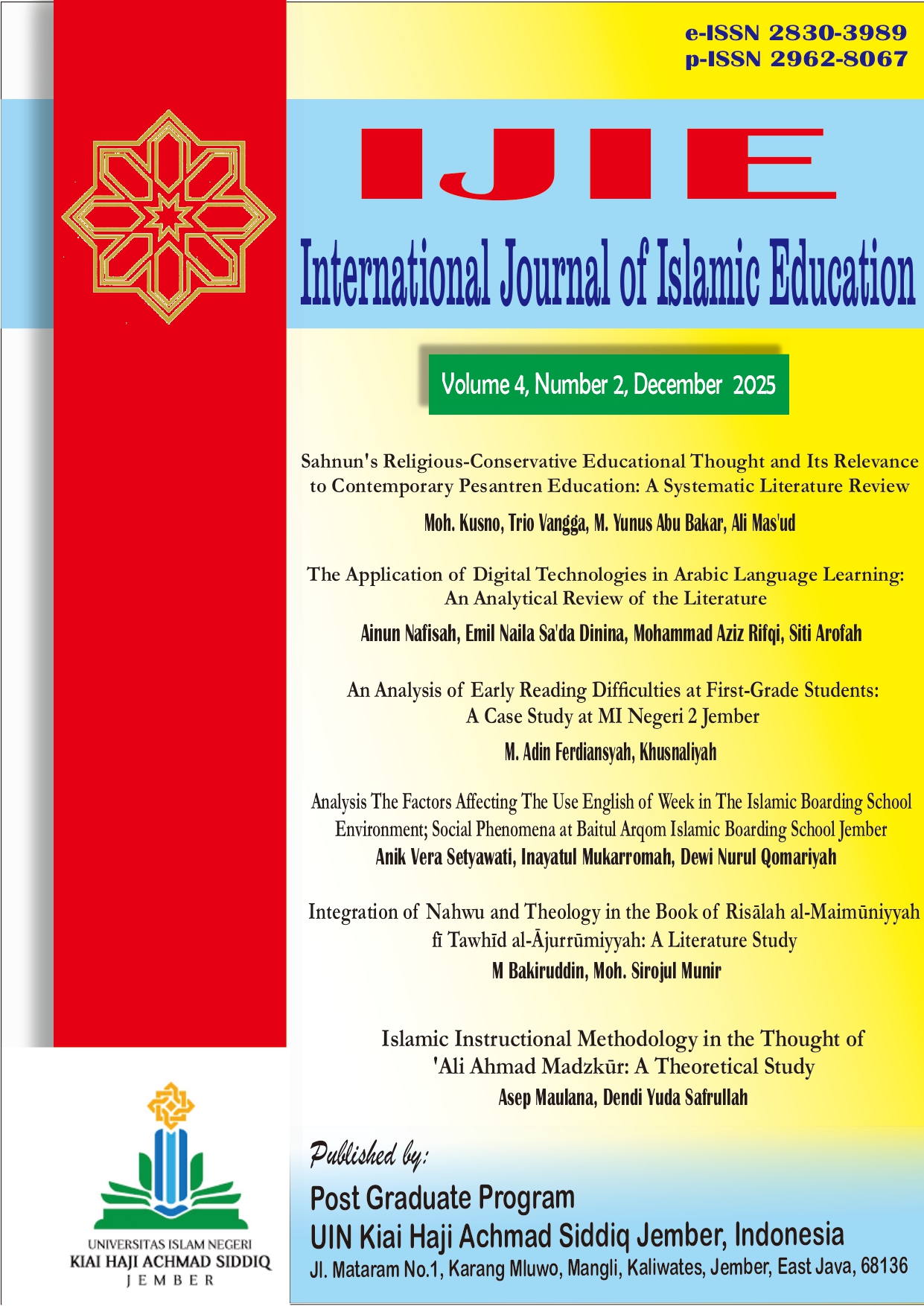
Islamic Instructional Methodology in the Thought of ‘Ali Aḥmad Madzkūr: A Theoretical Study
DOI:
https://doi.org/10.35719/ijie.v4i2.2423Keywords:
Islamic Learning Methodology, ʿAlī Aḥmad Madzkūr, Modern Pedagogy, Islamic EpistemologyAbstract
This study responds to the increasing need to renew Islamic instructional methodologies in light of contemporary pedagogical developments and 21st-century competency demands. The contributions of ʿAlī Aḥmad Madzkūr are central to this effort, as he proposes an educational framework that integrates revelation, rational inquiry, and lived experience as the epistemic foundation of Islamic pedagogy. The research examines four principal methods formulated by Madzkūr—exemplary modeling, dialogic learning, problem-solving, and observation combined with experimentation—while situating them in conversation with Western educational perspectives, especially those of Dewey, Kolb, and Bandura. It also analyzes his emphasis on instructional media as tools for clarifying abstract ideas, fostering active engagement, and linking theoretical concepts with practical realities, supported by a reflective-diagnostic evaluation system. Using a library-based research design, the study employs thematic, comparative, and synthetic analyses grounded in Madzkūr’s primary works and current pedagogical discourse. The findings show that his approach is integrative, merging ethical formation, rational development, and empirical inquiry into a unified pedagogical structure. Modeling cultivates moral character, discussion strengthens analytical thinking, observation and experimentation develop scientific habits of mind, and problem-solving enhances higher-order reasoning. Altogether, Madzkūr’s framework aligns with modern educational theories while offering a distinctive spiritual dimension, making it a promising and adaptable model for Islamic education.
References
Abrar, Muhammad. ‘Pendidikan Islam Dalam Perspektif Epistemologi Islam: Tantangan Dan Peluang Abad 21’. Jurnal Seumubeuet 4, no. 1 (2025): 44–59.
Aditiya, Ahmad Reza. ‘TEKNIK ANALISIS DATA DALAM PENELITIAN SOSIAL KEAGAMAAN’, n.d.
Aji, Muhammad Sukma, and Zainal Arifin. ‘Kritik Sosial Dalam Novel Orang-Orang Oetimu Karya Felix K. Nesi Serta Relevansinya Sebagai Bahan Ajar Di SMA: Tinjauan Sosiologi Sastra’. ENGGANG: Jurnal Pendidikan, Bahasa, Sastra, Seni, Dan Budaya 2, no. 1 (2021): 72–82.
Bandura, A, and P Hall. ‘Albert Bandura and Social Learning Theory’. Learning Theories for Early Years 78 (2018): 35–36.
Carpenter, Linda M, Taylor Murphy, and Tim M P Tait. ‘Phenomenological Cornucopia of SU (3) Exotica’. Physical Review D 105, no. 3 (2022): 35014.
Dalimunthe, Dewi Shara. ‘Transformasi Pendidikan Agama Islam: Memperkuat Nilai-Nilai Spiritual, Etika, Dan Pemahaman Keislaman Dalam Konteks Modern’. Al-Murabbi Jurnal Pendidikan Islam 1, no. 1 (2023): 75–96.
Darwati, Iga Mas, and I Made Purana. ‘Problem Based Learning (PBL): Suatu Model Pembelajaran Untuk Mengembangkan Cara Berpikir Kritis Peserta Didik’. Widya Accarya 12, no. 1 (2021): 61–69.
Dube, Swani, and Karma Zheba. ‘Integrating Modern Pedagogies into Islamic Education: Bridging Tradition with 21st-Century Innovation’. JMPI: Jurnal Manajemen, Pendidikan Dan Pemikiran Islam 3, no. 2 (2025). https://doi.org/https://doi.org/10.71305/jmpi.v3i2.567.
Gunawan, Gunawan, Ahmad Harjono, Kosim Kosim, Baiq Nabila Saufika Zainuri, and Qothrunnada Qothrunnada. ‘Multimodal Approaches In Problem-Based, Project-Based, And Inquiry-Based Learning Models In Science Education: A Systematic Literature Review’. Indonesian Journal Of Stem Education 7, no. 1 (2025): 1–17.
Ismanto, Heri, Rian Antony, and Carolus Borromeus Mulyatno. ‘Pengalaman Komunikasi Dialogis Para Guru Dalam Meningkatkan Kualitas Layanan Pendidikan: Teachers’ Dialogic Communication Experiences in Improving the Quality of Educational’s Service’. Wacana: Jurnal Bahasa, Seni, Dan Pengajaran 8, no. 1 (2024): 18–26.
Iswanto, Amin Rais, and Kholid Mawardi. ‘Integrasi Islam Dan Sains: Model Neo-Modernis Prespektif Nurcholish Madjid’. Jurnal Kependidikan 12, no. 1 (29 May 2024): 69–84. https://doi.org/10.24090/jk.v12i1.9802.
Khadijah, Ifah, M Wiran Jaya Nurhadi, Andri Wijaya, Ridwan Baiturrahman, Khalida Zia Fitrah Azahra, and M Syahbani Hambali. ‘Pengaruh Problem Based Learning Terhadap Kemampuan Memecahkan Masalah Peserta Didik’. Jurnal Pendidikan Indonesia: Teori, Penelitian, Dan Inovasi 5, no. 4 (2025).
M. Brookhart, Susan. ‘Assessment Literacy in a Better Assessment Future’. Chinese Journal of Applied Linguistics 46, no. 2 (27 June 2023): 162–79. https://doi.org/10.1515/CJAL-2023-0202.
Madzkur, Ali Ahmad. Manāhij Al-Tarbiyah: Ususuhā Wa Taṭbīqātuhā. al-Qohiroh: Dār al-Fikr al-‘Arabī, 2001.
———. Naẓariyyah Al-Manāhij Al-Tarbawiyah. Kairo: Dar el-Fikr al-Aroby, 2006.
———. Ṯuruqu Tadrīsi Al-Luġati Al-ʿArabiyyah. Oman: Dār al-Masīrah, 2010.
Muhammad Ikhlas Rosele, Firman Mansir, and Nurul Aisyah. ‘ISLAMIC EDUCATION METHOD IN IMPROVING THE RELIGIOUS LEARNING QUALITY IN MADRASAH IBTIDAIYAH’. AULADUNA: Jurnal Pendidikan Dasar Islam 11, no. 1 (19 June 2024): 1–9. https://doi.org/10.24252/auladuna.v11i1a1.2024.
Nasir, Muhammad, and Sunardi Sunardi. ‘Reorientasi Pendidikan Islam Dalam Era Digital: Telaah Teoritis Dan Studi Literatur’. Al-Rabwah 19, no. 1 (2025): 56–64.
Nurdiyanti, Yanti, Mohammad Yamin, and Izzudin Mustafa. ‘The Curriculum Basis of Islamic Education Perspective Ali Ahmad Madzkur’. Nazhruna: Jurnal Pendidikan Islam 5, no. 2 (23 May 2022): 555–71. https://doi.org/10.31538/nzh.v5i2.2001.
Octora, Kyana Listia, Elin Maulida Rahmawati, Ai Nurasih, and Khalimatus Sangdiyah. ‘Analisis Gaya Belajar Visual Dan Auditori Terhadap Motivasi Belajar Di SMP Negeri 1 Greged’. COUNSELIVE: Life Counseling Journal 1, no. 1 (2025): 36–43.
Parawansah, Siti Hanifah, and Ainur Rofiq Sofa. ‘Pendekatan Komprehensif Berbasis Al-Qur’an Dan Hadits Dalam Pengembangan Pendidikan Islam: Integrasi Nilai, Metode, Evaluasi, Sosio-Kultural, Dan Kompetensi Pendidik’. Karakter: Jurnal Riset Ilmu Pendidikan Islam 2, no. 1 (2025): 187–205.
Rahmi, Wifqi. ‘Analytical Study of Experiential Learning: Experiential Learning Theory in Learning Activities’. EDUKASIA Jurnal Pendidikan Dan Pembelajaran 5, no. 2 (2024): 115–26.
Rumina, Rumina. ‘INTEGRASI EPISTEMOLOGI ISLAM DALAM METODE PENDIDIKAN: PENDEKATAN FILSAFAT PENDIDIKAN ISLAM’. INOVATIF: Jurnal Penelitian Pendidikan, Agama, Dan Kebudayaan 11, no. 2 (20 September 2025): 215–33. https://doi.org/10.55148/inovatif.v11i2.1884.
Rustaman, Nuryani Y. ‘Pendidikan Dan Penelitian Sains Dalam Mengembangkan Keterampilan Berpikir Tingkat Tinggi Untuk Pembangunan Karakter’. In Proceeding Biology Education Conference: Biology, Science, Enviromental, and Learning, 8:15–34, 2011.
Saputra, Agus. ‘Pengaruh Model Discovery Learning Terhadap Hasil Belajar PAI Di Era Kurikulum Merdeka’. Jurnal Ilmu Tarbiyah Dan Keguruan 3, no. 1 (2025): 90–97.
Saura, Rida Wardatul, Alifahtul Zahro, Dhuhaa Isti’anah, Anggi Kurniawan, and Abdul Fadhil. ‘Pendekatan Pedagogis Problem-Solving Dalam Pendidikan Islam Untuk Mengatasi Degradasi Akhlak Remaja’. Jurnal Ilmu Pendidikan Dan Sosial 4, no. 2 (2025): 163–77.
Sumianto, Sumianto, Adi Admoko, and Radeni Sukma Indra Dewi. ‘Pembelajaran Sosial-Kognitif Di Sekolah Dasar: Implementasi Teori Albert Bandura’. Indonesian Research Journal on Education 4, no. 4 (2024): 102–9.
Syafiqoh, Irma, Rizqy Rahmawati, Sukma Nur Izzati, Atikah Nurhasanah, Muhammad Mahdi Satria Maulana, and Armai Arief. ‘METODOLOGI PENGEMBANGAN KEILMUAN: EPISTEMOLOGI 2 MENCAKUP (EXPLANATION) BAYANI,(INTUISI) IRFANI, DALAM PERSPEKTIF ISLAM DAN BARAT’. Jurnal Pendidikan Integratif 6, no. 2 (2025).
Wijayati, Ida Wahyu. ‘Urgensi Memahami Ketiganya Bagi Guru Dan Mahasiswa Pendidikan’. Asesmen Pembelajaran: Teori Dan Praktik 34 (2025).
YAZID, MUHAMMAD. ‘Filsafat Islam Sebagai Landasan Pedagogi:: Menciptakan Lingkungan Belajar Yang Inklusif Dan Holistik’. Jurnal Man-Anaa 2, no. 1 (2025): 1–12.
Zedan, Ashraf M., Mohd Yakub Zulkifli Bin Mohd Yusoff, and Mr. Roslan Bin Mohamed. ‘An Innovative Teaching Method in Islamic Studies: The Use of PowerPoint in University of Malaya as Case Study’. Procedia - Social and Behavioral Sciences 182 (May 2015): 543–49. https://doi.org/10.1016/j.sbspro.2015.04.776.